EM vs GPR Utility Locating: What’s the Difference and When Do You Need Both?
When planning excavation, trenching, or site development in Georgia, one of the most common questions we hear is:
What’s the difference between EM and GPR utility locating — and do I need both?
Both technologies are used to detect underground utilities, but they work in very different ways. Understanding how each method works helps property owners and contractors make informed decisions before breaking ground.
Let’s walk through it.
What Is EM Utility Locating?
Electromagnetic (EM) utility locating is used to detect conductive underground utilities.
This includes utilities such as:
Electric lines
Gas lines
Telecommunications cables
Copper lines
Some tracer-wired utilities
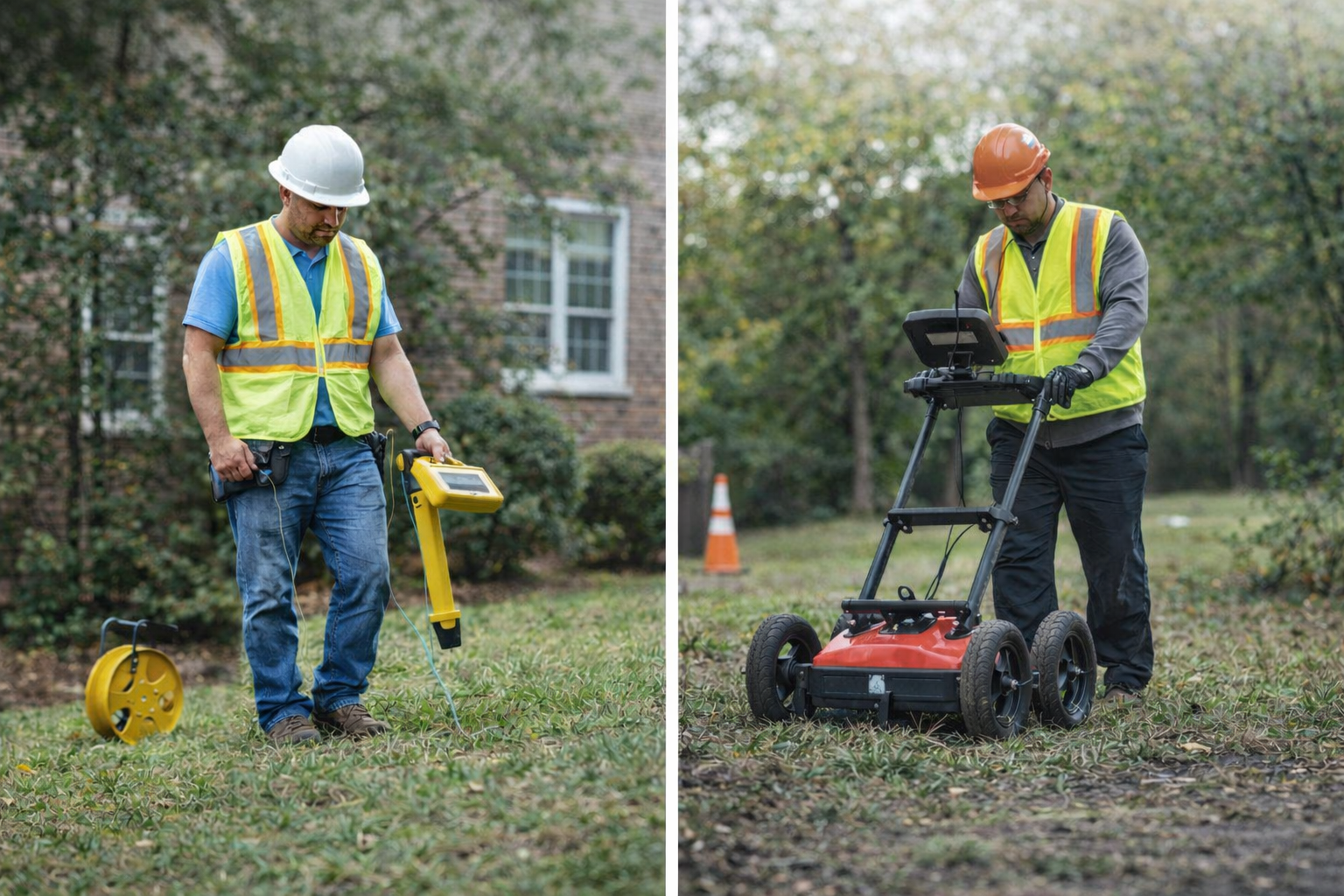
EM locating works by applying or detecting an electrical signal on a conductive line. The locator tracks that signal from the surface, identifying the utility’s path and estimated depth.
When EM Works Best
EM utility locating in Georgia is especially effective when:
Utilities are metallic or conductive
A tracer wire is present
Lines are continuous and grounded properly
For many commercial and public utilities, EM locating is highly accurate and efficient.
What Is GPR Utility Locating?
Ground Penetrating Radar (GPR) works differently.
Instead of detecting electrical signals, GPR sends radar pulses into the ground and reads reflections from buried objects.
This makes GPR especially useful for detecting:
PVC water lines
Sewer lines
Non-conductive pipes
Unknown or abandoned utilities
Underground structures or voids
Because GPR does not rely on conductivity, it can identify utilities that EM may not detect.
When GPR Works Best
GPR utility locating is particularly helpful when:
Utilities are non-metallic
No tracer wire is present
Site documentation is incomplete
Underground congestion is suspected
In many Georgia commercial properties, GPR plays a critical role in identifying private utilities.
Why EM and GPR Are Often Used Together
While EM and GPR are powerful tools individually, they provide the best results when combined.
Here’s why:
EM confirms conductive utilities
GPR identifies non-conductive utilities
GPR can detect unknown or abandoned lines
EM helps trace lines over longer distances
Using both technologies increases confidence, improves accuracy, and reduces the risk of missed utilities.
For contractors working in Metro Atlanta or across Georgia, combining EM and GPR provides a more complete picture of what lies below the surface.
Limitations to Understand
No locating technology is 100% perfect. Conditions that can impact results include:
Soil composition
Ground moisture
Utility depth
Congested underground environments
Poor tracer wire installation
This is why experienced, properly trained technicians — especially those following NULCA industry standards — are essential to the process.
Accuracy depends not just on the equipment, but on how it is used.
When Should You Use Both EM and GPR?
In Georgia, using both EM and GPR is strongly recommended for:
Commercial site development
Large residential properties
Apartment complexes
Industrial sites
School or municipal campuses
Projects involving directional boring
Areas with unknown utility history
If your project involves significant excavation or high risk, combining both methods helps reduce uncertainty.
Why This Matters Before Excavation
Utility strikes can result in:
Costly repairs
Project delays
Safety hazards
Service interruptions
Liability exposure
Understanding the difference between EM and GPR utility locating helps ensure the right technology is used for the right site conditions.
For contractors and property owners in Georgia and the Southeast, informed preparation is one of the best ways to protect your project.
Final Thoughts
EM and GPR utility locating are not competing technologies — they are complementary tools.
EM is excellent for tracing conductive utilities.
GPR is essential for detecting non-conductive or unknown lines.
Together, they provide a more complete understanding of underground conditions before excavation begins.
If you’re unsure which method your project requires, a professional utility locating provider can help determine the appropriate approach based on site conditions and scope.
Before breaking ground, knowing what lies below can make all the difference.
Accuracy You Can Build On.